
Dir: Lynne Ramsay
Cast: Jennifer Lawrence, Robert Pattinson, Sissy Spacek, LaKeith Stanfield, Nick Nolte
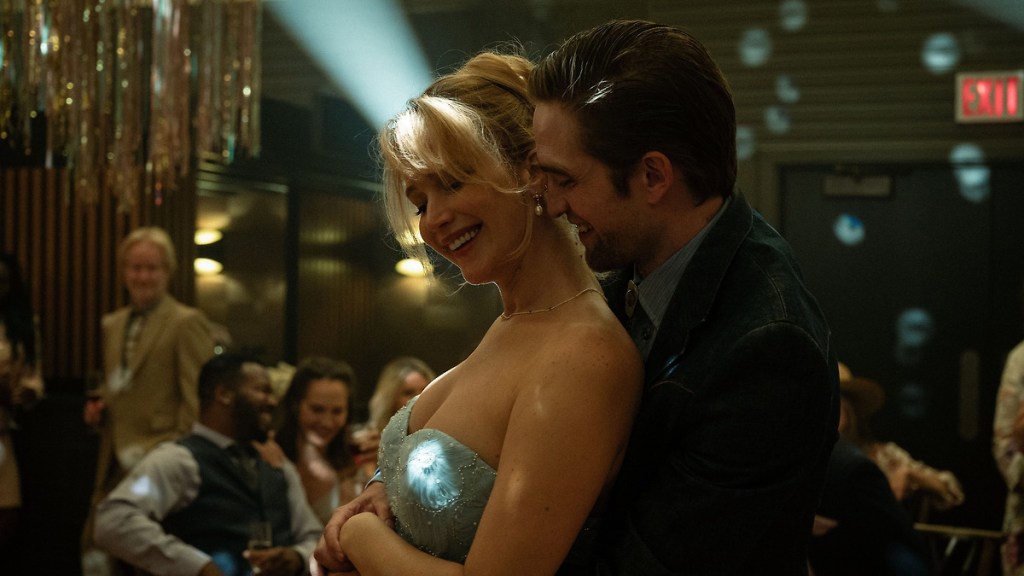
Lynne Ramsay’s fearless portrayal of postpartum depression might challenge some viewers with its experimental edge, yet Jennifer Lawrence’s raw performance and daring visuals make for an unforgettable exploration of mental health
In a film landscape still hungry for bold visionaries, few have shaken audiences over the past couple of decades quite like Scottish director Lynne Ramsay. Since her feature-length debut twenty-six years ago, Ramsay has carved out a reputation for challenging viewers with her daring style and fearless exploration of weighty themes. Whether it is the haunting loss of innocence in the hard-to-stomach “Ratcatcher” (1999), the relentless cycle of violence and child trafficking in “You Were Never Really Here” (2017), or the raw complexities of motherhood and postpartum depression in “We Need to Talk About Kevin” (2011), Ramsay’s films are unafraid to confront the darkest corners of the human experience.
Echoing the sensitivity she brought to her aforementioned adaptation of Lionel Shriver’s controversial novel, Ramsay’s latest film, “Die My Love”, plunges into the turbulent waters of motherhood and the mental health struggles that often accompany it. In “We Need to Talk About Kevin”, the story revolved around a mother grappling with the aftermath of her son’s horrific actions, brought to life by Tilda Swinton’s unforgettable performance. This time, Ramsay shifts her lens inward, focusing on the mother’s own psychological turmoil as Jennifer Lawrence’s character is swept into the depths of postpartum depression after her child’s birth.
Jennifer Lawrence first encountered Ariana Harwicz‘s Spanish-language novel, from which the film is based, in 2022. At that time, legendary filmmaker Martin Scorsese, having discovered it through his book club, sent it her way. Though he had never collaborated with the “Hunger Games” star, Scorsese imagined her at the heart of an English-language adaptation. Inspired, Lawrence set out to find a director bold enough to bring the novel’s intensity to the screen, eventually reaching out to Ramsay. After some initial hesitation, given the thematic echoes of some of her previous works, Ramsay agreed to take on the adaptation.
The film made its debut at this year’s Cannes Film Festival, then journeyed through the European festival circuit, including stops in London and Rome, before landing in UK cinemas via distributor Mubi last Friday, where I was lucky enough to catch it on opening day.
From the outset, we meet the young, free-spirited couple Grace (Jennifer Lawrence) and Jackson (Robert Pattinson), who have traded the bustle of New York for the wide-open spaces of rural Montana, hoping to give Grace the creative space she craves for her writing. The couple inherits a crumbling farmhouse from Jackson’s late uncle, who had recently committed suicide, and before they can even begin to restore it, they are thrust into parenthood with the arrival of their baby boy.
As the couple navigates their new surroundings and responsibilities as parents, Grace finds herself trapped in the unfinished house, battling isolation and longing, while Jackson is often absent due to work, with her unraveling mental state sending their marriage into a storm of uncertainty and unease.
Although I consider myself well-acquainted with Ramsay’s work, her latest exploration of postpartum depression still managed to surprise me with its bold, experimental spirit. The Glaswegian director seems determined to break away from her established patterns, both in structure and narrative, forging a path that feels refreshingly unpredictable. This new project stands shoulder to shoulder with her most provocative films, yet even I found myself questioning what was real and what was imagined on screen. The film’s ambiguity mirrors the unravelling mind of Lawrence’s character, but the tangled, non-linear storytelling and unreliable narration can make it a challenging watch—one that will likely lose some viewers along the way, and whilst I was on board with Ramsay’s experimental approach, I will find it hard to come back for a rewatch with its repetitive story beats resulting in it dragging at times. I want to stress that this film is not for everyone, and if you are intrigued by it, I recommend a little research into its structure, themes, and tone before diving in. It’s an intense experience, and the unexpected weight of it may explain why several people left my screening halfway through.
This film feels like a spiritual sibling to Lawrence’s equally demanding “Mother!” (2017). While that film uses a crumbling house to reflect humanity’s neglect of the planet, here the house becomes a living metaphor for Grace and Jackson’s fractured relationship. In Darren Aronofsky’s psychological drama, the house is Earth itself, decaying as humanity turns its back on it. In “Die My Love”, the home is always in disrepair, sometimes even sabotaged by Grace’s own hands, echoing her internal chaos. The house is not just a setting but a cage, confining Grace’s wild spirit and amplifying her sense of isolation, even as she clings to her love for her family. Grace’s inner world bursts through in striking images of nature, wild horses, and sweeping rural vistas, all captured with breath-taking artistry by Seamus McGarvey. The Irish cinematographer’s choice of a 4:3 aspect ratio tightens the frame, heightening Grace’s claustrophobia as she feels trapped by domestic convention, and also helps blur the line between reality and dream.
The true force behind “Die My Love” is undeniably Jennifer Lawrence, who has championed this project since its inception. Though I have not read the original Argentinian novel, Lawrence throws herself into the role of a mother grappling with postpartum depression, her sense of confinement fuelling a downward spiral that fractures both her relationships and her creative spark. This is Lawrence at her most fearless, delivering a performance that is not only the most demanding of her career but arguably her finest yet. Despite a positive postpartum experience after her first child, Lawrence has shared that filming “Die My Love” was gruelling, especially as she was midway through her second pregnancy. Her portrayal is raw and electrifying, requiring a level of physical and emotional intensity that is remarkable for anyone, let alone someone over four months pregnant, and stands as one of the year’s most powerful and unforgettable performances.
The supporting cast also delivers across the board, even if their main function is to heighten Grace’s frustration. Pattinson is utterly convincing as the well-intentioned husband who somehow manages to get everything wrong, and it is a thrill to watch the “Twilight” star push his craft with daring filmmakers. Sissy Spacek and Nick Nolte shine in their minor roles as Jackson’s parents, with Spacek’s character emerging as a rare confidante for Grace, a kindred spirit who has weathered similar storms.
The Verdict:
Ramsay’s latest project dazzles both technically and thematically, reaffirming her place as one of the industry’s most daring and evocative female filmmakers. While the film’s repetitive narrative beats mirror the lead character’s unravelling mind and occasionally slow the pace, its unconventional, unreliable structure may challenge some viewers. However, Jennifer Lawrence delivers a performance so raw and fearless that it alone makes the film unmissable.
Die My Love is now showing in UK Cinemas
 Dan Loves Film
It’s interesting that another film out right now, “If I Had Legs I’d Kick You” also features a mesmerizing female performance – this one by Rose Byrne, who showcases a woman trying to take care of a sick daughter while balancing her career and an absent husband…they both seem to focus on the unique pressures faced by Moms – and the world that expects so much of them and offers such little support. Both Actresses will be Oscar-nominated I think and deservedly so!
LikeLiked by 1 person