
Dir: Timur Bekmambetov
Cast: Chris Pratt, Rebecca Ferguson, Kali Reis, Annabelle Wallis, Chris Sullivan, Kylie Rogers
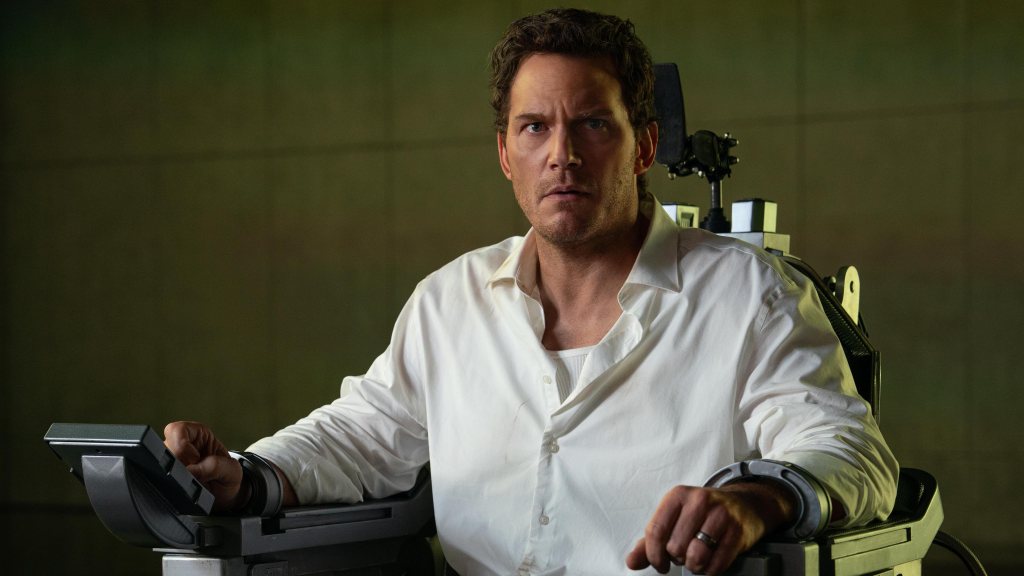
This clunky and lifeless screenlife thriller stumbles over its own ambitions, missing the pulse-pounding excitement expected of a high-concept sci-fi flick, and squandering its to stars by misusing their talents
“Mercy” marks the latest chapter from Kazakh-Russian director Timur Bekmambetov, who first burst onto the scene over twenty years ago with the supernatural fantasy “Night Watch” in 2004. Having broken box-office records in its native Russia, the sequel, “Day Watch”, only amplified the buzz, leading Fox Searchlight to snap up both for global release. Over the years, “Night Watch” has earned cult status, with fans as notable as Quentin Tarantino and James Gunn even championing it. While I found the Russian-language vampire saga entertaining, it never quite sank its fangs into me the way other vampire films have.
Bekmambetov’s newfound fame landed him in Hollywood, where he helmed the gleefully over-the-top action romp “Wanted” in 2008, complete with bullet-curving James McAvoy and a formidable Angelina Jolie. Despite a flurry of projects and even a brief creative partnership with Tim Burton, Bekmambetov has struggled to recapture the success of his breakout Hollywood hit. Instead, he carved out a niche as a pioneer of the screenlife genre, reflecting our society’s digital migration over the years. These films tend to unfold through the eyes of computers and smartphones, a technique that truly shone in the gripping mysteries “Searching” (2018) and “Missing”(2023), both produced by Bekmambetov. By zeroing in on characters reeling from the sudden loss of loved ones, these stories pull viewers into the raw, modern reality of DIY investigations, powered by the very devices we use every day, and anchored by heartfelt performances.
At their best, screenlife films offer a fresh, innovative spin on storytelling, transcending their seemingly gimmicky format. But when mishandled, they quickly devolve into lifeless affairs, starved of action and chemistry, limping along in search of thrills that never arrive. Nothing illustrates this better than last year’s disastrous “War of the Worlds” update, where a bewildered Ice Cube watched the alien-invasion apocalypse unfold from his laptop, cementing its reputation as 2025’s cinematic low point.
With “Mercy”, Bekmambetov returns to the screenlife format as a director for the first time since 2018’s “Profile”, but the film stumbles over the same pitfalls that have tripped up lesser entries in the genre, squandering its intriguing high-concept setup. We’re thrust straight into the ordeal of LAPD Detective Chris Raven (Chris Pratt), who jolts awake, bound and accused of murdering his wife, Nicole (Annabelle Wallis). In this near-future Los Angeles, Chris is a vocal supporter of the “Mercy” court, a new system designed to curb violent crime by putting defendants on trial before AI judges. These digital arbiters grant suspects ninety minutes and full access to evidence to prove their innocence, or else face execution by sonic blast.
Presiding over Chris’ case is AI Judge Maddox (Rebecca Ferguson), who informs him that all evidence implicates him in his wife’s murder, with him currently facing a guilt probability of 97.5%, which he must lower to 92% to prevent execution. Utilising his own detective skills and expansive access to personal and private information kept in the citywide cloud network, Chris seeks out his wife’s actual killer.
“Mercy” may not plumb the depths of “War of the Worlds”, but it hardly earns its place on the big screen. In an era when streaming platforms such as Netflix side-line gorgeous cinematic gems like “Train Dreams” and “Frankenstein”, it is all the more exasperating to see a film that feels tailor-made for streaming dominate theatre screens. This derivative sci-fi thriller borrows liberally from the likes of Philip K. Dick and countless others, yet offers little new in terms of action or suspense. The initial setup—Pratt’s character strapped to a futuristic electric chair—offers a flicker of intrigue, but the film’s tension fizzles fast, undone by sluggish pacing and mystery clichés.
The handful of action sequences, glimpsed through the protagonist’s screens, feel hurried and lack urgency—the ninety-minute countdown never truly registers as a threat. With so few suspects in play, the story’s twists are telegraphed well in advance, draining the mystery of any real weight. Where “Searching” and “Missing” expanded their worlds by sending characters far and wide despite the screenlife setup, “Mercy” confines itself to a claustrophobic circle of phone calls and conveniently rapid police responses, making the whole affair feel small and stifled.
Both Pratt and Ferguson find their talents squandered here. While Pratt may not be the most convincing dramatic actor, his Marvel roles have shown he can be a magnetic, engaging lead. Here, though, he is literally and figuratively confined, spending most of the film strapped to a chair in a sterile void as digital screens whiz by. Ferguson, on the other hand, is a serious, dramatic acting talent, and you only have to go back a couple of months to have seen her true potential in a far superior ticking-clock thriller, Kathryn Bigelow‘s “A House of Dynamite”. Having been reduced to playing an AI judge, her emotional range is stifled, and what begins as an intriguing dynamic between her and Pratt’s character soon devolves, as her AI persona starts to inexplicably sympathise with the accused detective.
Which brings me to the film’s greatest failing, its lack of meaningful social commentary. “Mercy” teases urgent themes—rampant AI, aggressive policing, and the erosion of privacy in a hyper-connected world. Chris’s trial grants him sweeping access to the private lives of everyone in the city, thanks to a citywide cloud mandate, but the social and moral implications of this are never questioned, with only his daughter ever seeming to be upset by the justice system’s intrusive nature. Instead of digging into these timely issues, the film settles for a bland, by-the-numbers thriller, squandering the rich possibilities of its premise.
The Verdict:
Though it sparks a flicker of curiosity at first, this clumsily crafted and uninspired screenlife thriller fizzles out quickly, offering none of the sharp insights or pulse-pounding excitement found in standout sci-fi films. By muzzling its talented cast, it leaves viewers adrift, untouched by any real emotion or suspense.
Mercy is now showing in UK Cinemas
 Dan Loves Film