
Dir: Johannes Roberts
Cast: Johnny Sequoyah, Jessica Alexander, Victoria Wyant, Gia Hunter, Benjamin Cheng, Troy Kotsur, Miguel Torres Umba
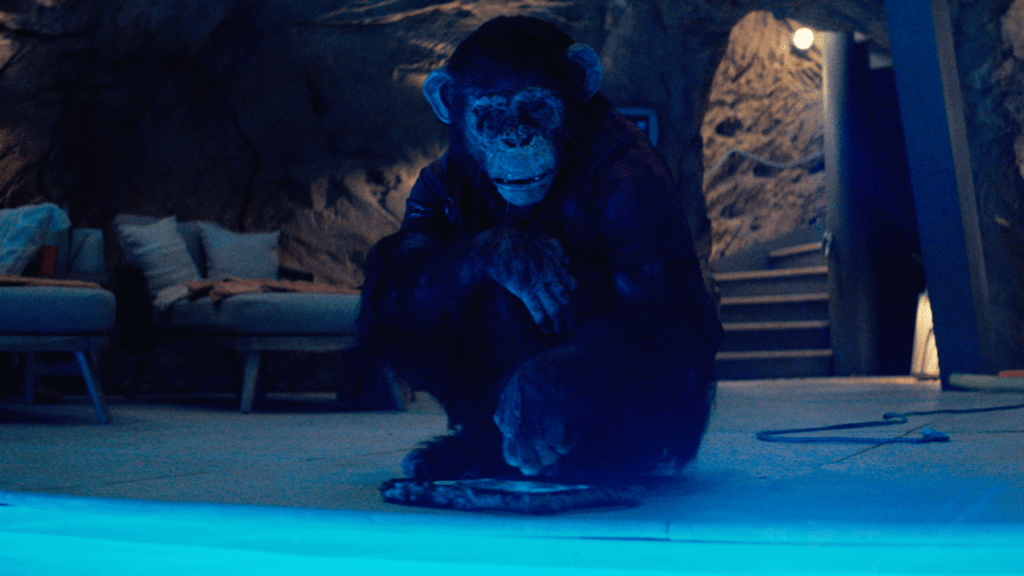
This bananas creature feature may be instantly forgettable, but there is undeniable fun in watching a frenzied chimpanzee tear through his hapless victims with ruthless and bloody efficiency
“Primate” is the latest offering from British filmmaker Johannes Roberts, whose career has spanned a fascinating range of horror genre fare since his early days. My first encounter with Roberts’ work was 2010’s eerily atmospheric, British high school slasher “F”, a film shot on a shoestring budget but loaded with a palpable sense of dread. Sixteen years later, “Primate” demonstrates just how far Roberts has come in his craft. The evolution is clear not only in his technical prowess but also in his willingness to experiment with narrative conventions, even as certain familiar themes and motifs persist throughout his filmography. As in his aquatic thrillers “47 Metres Down” and its sequel, Roberts again puts hapless protagonists in extraordinary peril, this time swapping sharks for a far more unusual—and unsettling—predator: a chimpanzee.
Roberts’s fondness for pitting outmatched, and often quite idiotic, protagonists against relentless threats remains unchanged. In “F” and the somewhat underappreciated “The Strangers: Prey at Night” (2018), the antagonists were anonymous, faceless figures lurking in the shadows. In his “47 Metres Down” series, it was the inescapable, razor-toothed menace of nature itself. “Primate” takes a slightly different approach, imbuing its killer with a distinct personality. Ben, the titular chimpanzee, is more than just a mindless beast; he’s a character in his own right, brought to life through a physically demanding and deeply committed performance by Miguel Torres Umba. This adds a layer of complexity rarely seen in the modern creature-feature subgenre, where monsters are often little more than bloodthirsty plot devices.
The film wastes little time establishing its central dynamic. Ben is the beloved pet of Adam (Troy Kotsur), a successful author who has woven his own deafness into a celebrated series of novels. Adam’s bond with Ben is rooted in years of careful training, culminating in the chimp’s ability to communicate via sign language. The film explores this relationship with surprising sensitivity, showing how Adam’s disability is not a hindrance but rather a bridge to a unique form of interspecies connection. Adam’s home, perched on a sun-drenched Hawaiian cliffside, is both idyllic and isolated—a detail that serves the film’s claustrophobic tension well.
Living with Adam is his youngest daughter, Erin (Gia Hunter), while his eldest, Lucy (Johnny Sequoyah), has long since moved away to attend college. The narrative’s inciting incident comes when Lucy returns home to reconnect with her father and sister, accompanied by lifelong friends Kate (Victoria Wyant) and Nick (Benjamin Chang). Both are familiar with Ben and treat his presence with casual ease. However, newcomer Hannah (Jessica Alexander), tagging along much to Lucy’s dismay, is instantly unnerved by the chimpanzee’s imposing presence. This dynamic sets up a classic horror scenario: a group of young people stranded and ill-prepared for the horrors to come.
The plot is set in motion when Adam, preparing to leave for a book signing, notices Ben acting strangely after suffering a bite and discovering a dead mongoose. Despite assurances from a local vet that rabies has been eradicated from the islands, the group soon finds themselves under siege from a frenzied Ben. The familiar trappings of the “rabid animal” sub-genre come into play, echoing Stephen King’s “Cujo”, itself adapted into a feature film in 1983, with the obvious substitution of animal: Ben, once gentle and beloved, transforms into a terrifying force of nature. As the virus takes hold, he becomes increasingly violent, stalking and dispatching the group with brutal efficiency.
While “Primate” doesn’t strive for originality in its basic premise, the execution is sharp and effective. Roberts keeps the narrative lean, never bogging down the pace with unnecessary exposition. At a brisk 80 minutes, the film delivers an adrenaline-fueled ride that refuses to overstay its welcome. The tension is palpable from the moment Ben first lashes out, and the sense of danger only escalates as the body count rises. Roberts deftly balances suspense and shock, crafting set pieces that make inventive use of the home’s architecture—particularly a cliffside swimming pool that subverts the “Jaws”-inspired trope of danger lurking in the water. Here, the water becomes a rare sanctuary, flipping expectations and forcing characters into ever-more desperate gambits for survival when they are on land.
The home’s production design is also a standout element, with the house itself serving as both fortress and prison. It’s tailored to accommodate Adam’s needs and Ben’s abilities, creating a believable environment where the action unfolds organically. The use of shadows, tight corridors, and lush Hawaiian foliage gives Roberts plenty of opportunities to stage sudden, impactful scares. The environment becomes a character in its own right, amplifying the film’s sense of isolation and dread.
What truly elevates “Primate”, however, is the emotional resonance provided by Troy Kotsur’s performance, a real get following his Oscar win for “CODA” a few years ago. As Adam, Kotsur brings a grounded, lived-in quality to the role, infusing his interactions with Ben and his daughters with warmth and vulnerability. This emotional core makes the eventual violence all the more harrowing. The tragedy of Ben’s transformation from beloved companion to rampaging threat is keenly felt, thanks in no small part to Kotsur’s portrayal and the film’s willingness to linger on moments of quiet grief amid the chaos.
The supporting cast delivers solid work despite largely being used as disposable fodder. Gia Hunter and Johnny Sequoyah convincingly portray sisters whose relationship is tested by trauma. Jessica Alexander’s Hannah, initially an outsider, provides an effective audience surrogate, reacting with genuine fear and disbelief as events spiral out of control. Each character is sketched just enough to invest the audience in their fates, even as they fall victim to the genre’s penchant for grisly demises.
Speaking of violence, “Primate” is not for the faint of heart. Roberts, never one to shy away from gore, orchestrates Ben’s rampage as he pummels, bludgeons, scalps, and tears through his victims with a gleeful sense of excess. Practical effects are employed to great impact, with each kill feeling satisfyingly visceral and appropriately shocking. The film rightfully earns its 18 certificate in the UK, pushing the boundaries of what mainstream horror will show without tipping into gratuitousness. The brutality is always in service of the story, reinforcing the film’s sense of unpredictability and terror.
The Verdict:
In the end, “Primate” may not reinvent the wheel, but it spins it with style. Roberts’s command of tension, character, and spectacle is on full display, resulting in a film that is both frightening and unexpectedly heartfelt. It’s a brisk, bloody, and thoroughly entertaining entry in the modern creature feature canon—one that proves there’s still plenty of life (and death) in the genre’s familiar formulas, provided they’re executed with this much conviction and craft.
Primate is now showing in UK Cinemas
 Dan Loves Film
Great review. “…disposable fodder.” 😂
LikeLiked by 1 person