Dir: Emerald Fennell
Cast: Margot Robbie, Jacob Elordi, Hing Chau, Shazad Latif, Alison Oliver, Martin Clunes, Ewan Mitchell, Owen Cooper
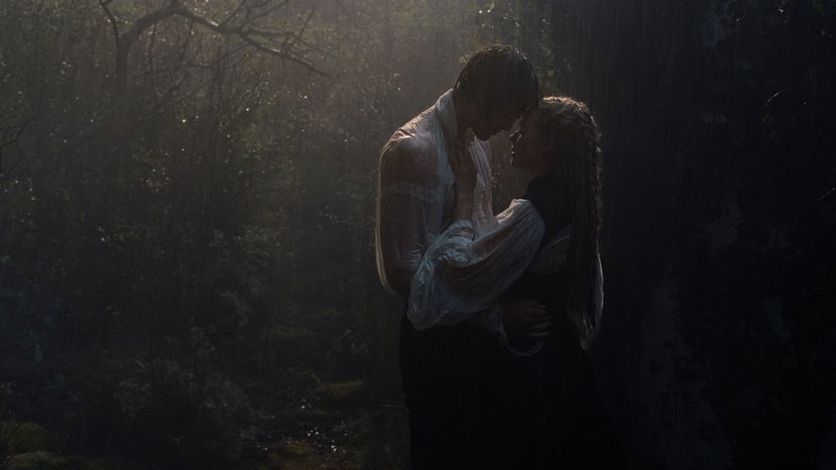
Emerald Fennell’s bold interpretation of “Wuthering Heights” is sure to ruffle the feathers of purists, but there is no denying that her fearless vision brings a fresh and unexpected energy to Emily Bronte’s classic tale
British filmmaker Emerald Fennell has quickly become one of Hollywood’s most daring and talked-about voices. With just two feature films before her latest, “Wuthering Heights”, Fennell has already built a reputation for challenging audiences with fearless, sometimes polarizing explorations of cultural and social issues. Her debut, the excellent, neon-soaked “Promising Young Woman”(2020), boldly turned the rape-revenge genre on its head, forcing viewers to confront the raw realities of misogyny and victim blaming. Fennell’s fearless storytelling earned her an Academy Award for screenwriting on her very first try. As a devoted fan of her debut, I was eager to see what she would deliver next.
I had the chance to experience her second film, “Saltburn”, at the 2023 London Film Festival’s opening night gala. Though it divided critics and audiences even more than her debut, I found myself drawn to its outrageous, campy energy and unapologetic black comedy. While “Saltburn” didn’t sweep the awards circuit like “Promising Young Woman”, its wild, provocative scenes catapulted Fennell into the mainstream, turning the film into a viral talking point.
After her almost vampiric take on class warfare, I wasn’t surprised to hear Fennell would tackle Emily Brontë’s “Wuthering Heights” for a modern audience, promising to jolt the classic with a raw, sexual charge. The novel has seen countless adaptations over the years, most focusing on the tragic romance of Catherine and Heathcliff, even though that’s just a sliver of its complexity. I’ll admit, I’ve never read “Wuthering Heights” myself, so my perspective is shaped entirely by how Fennell and other filmmakers have reimagined it for the screen.
From the very first scene, Fennell’s adaptation signals its intent: lust and sexuality pulse through the film, beginning with a shocking image of a hanged man with a visible erection in a Yorkshire square. Yet, beneath the provocative surface, the story follows familiar lines. We meet young Catherine Earnshaw (Charlotte Mellington) and her paid companion, Nelly (Vy Nguyen), as they witness the execution that whips the crowd into a frenzy. The pair reside at the windswept Wuthering Heights estate, ruled by Cathy’s abrasive, hard-drinking father, Mr. Earnshaw (Martin Clunes). In a drunken haze, Mr. Earnshaw brings home a battered boy from the streets of Liverpool (Owen Cooper), declaring him Cathy’s new “pet” and christening him Heathcliff after her late brother.
As the years pass, now adult Cathy (Margot Robbie) and Heathcliff (Jacob Elordi) have grown inseparable, their bond simmering with unspoken desire, much to Nelly’s (Hong Chau) disapproval. Yet, the chasm of class keeps their passion unfulfilled, with Cathy fearing the shame their union might bring. When Cathy sets her sights on new, wealthy neighbour Mr. Linton (Shazad Latif) to save her family’s crumbling estate, the heartbreak drives Heathcliff away—only for him to return years later, intent on settling old scores.
Much has already been said about Fennell’s take on Brontë’s classic, with critics quick to point out its departures from the original novel. Fennell herself describes the film as a personal interpretation, shaped by her teenage reading of the novel when she was fourteen. While I can’t judge its fidelity, I can say Fennell excels at dragging nineteenth-century literature into the present with her bold, distinctive visuals. Sure, some character nuance may be lost—subtlety isn’t Fennell’s trademark—but I’d rather see a filmmaker take a wild, creative risk than churn out another safe, forgettable adaptation.
True to form, Fennell delivers a visual feast: costumes burst with colour, interiors are exaggerated and lush, and the whole production feels like a dream conjured by a young reader’s imagination. Linus Sandgren’s cinematography turns every shot into a spectacle, heightening colours and textures to create an uncanny, almost gothic atmosphere reminiscent of his previous work with Fennell on “Saltburn”. The visuals pair perfectly with Anthony Willis’ anachronistic score, which weaves seamlessly with Charlie XCX’s contemporary music. Some may find the absence of period-appropriate music jarring, with one montage in particular guilty of veering into music-video territory, but overall, the modern, electronic soundtrack feels right at home in this bold reimagining. The effect reminded me of Baz Luhrmann’s earlier work, particularly his modern retelling of “Romeo + Juliet” (1996), which catapulted Shakespearean tragedy onto the streets and beaches of 90s California.
If you’re after a more faithful, historically grounded adaptation, Andrea Arnold’s 2011 version is the one to watch, with Kaya Scodelario and James Howson—whose casting sparked debate due to his race. The conversation has reignited with Elordi’s casting as Heathcliff, with some calling it whitewashing. While honouring the character’s racial ambiguity could have deepened the story’s tension, it seems unfair to single out this film when so many previous adaptations have cast white actors in the role, from Tom Hardy to Laurence Olivier.
Putting the casting debate aside, Elordi delivers a standout performance as Heathcliff. While his presence doesn’t fully capture the social chasm between the lovers, he brings a brooding intelligence and imposing physicality to the role. The Australian actor uses his height and stature to great effect, building on the intensity he showed as the Monster in Guillermo del Toro’s “Frankenstein”.
Robbie, on the other hand, didn’t quite win me over. She’s a powerhouse talent and a major force in Hollywood, but here, I couldn’t shake the sense that I was watching Margot Robbie rather than Catherine. Despite her track record with accents, she sidesteps the Yorkshire dialect, settling for a polished English accent, while Elordi fully inhabits his character’s working-class Yorkshire roots.
The chemistry between the leads is fascinating, if unconventional. Not having read the novel, I wasn’t sure how their romance was meant to play out, but what struck me most was how their lust masquerades as love—two feelings easily confused. I never quite believed them as lovers, but that actually serves the film, highlighting how their unchecked desire leads to ruin. Their intimate moments, mostly in the latter half, are surprisingly restrained; while there are hints of BDSM, nothing feels gratuitous. The real provocation lies in injecting sexual frankness into a story that, in its own era, would have been forbidden from referencing such acts of debauchery.
The supporting cast shines, and I remain a devoted fan of Hong Chau, who brings real depth to Nelly—the film’s most layered character, shaped by jealousy and the sting of discrimination, who ultimately is responsible for the direction our star-crossed lovers’ relationship takes. The real standouts, though, are a hilarious, scene-stealing Alison Oliver as the delightfully eccentric, ribbon-obsessed Isabella, while Martin Clunes is nearly unrecognisable as the perpetually drunk and despicable Mr. Earnshaw.
The Verdict:
Emerald Fennell delights in pushing boundaries and stirring up her audience, and her wonderfully strange take on Emily Brontë’s classic is sure to spark debate. Yet, if you are open to being carried away by its eccentric charm, you will find much to savour, even if it strays from the original story.
“Wuthering Heights” is now showing in UK Cinemas
 Dan Loves Film
Interesting…
LikeLiked by 1 person
Always enjoy your reviews…interesting how a “middle of the road” approach to filmmaking is dull but heaven forbid a bold take ruffles feathers!
LikeLiked by 1 person