Dir: Nia DaCosta
Cast: Ralph Fiennes, Jack O’Connell, Alfie Williams, Erin Kellyman, Chi Lewis-Parry, Emma Laird, Sam Locke
Fiennes and O’Connell deliver riveting performances in this brutal yet unexpectedly hilarious fourth instalment chapter, as Alex Garland’s zombie saga fearlessly continues to venture into thrilling new territory
Check out my “28 Years Later” review here:
After lying dormant for eighteen years, Alex Garland‘s iconic “28 Days Later” franchise clawed its way back to life in 2025. Anticipation for the summer release reached fever pitch, fuelled by the original film’s lasting cultural shadow, aswell as a masterful marketing campaign, capped by a trailer that became an instant sensation. The eerie, rhythmic rendition of Rudyard Kipling‘s 1903 poem “Boots” lingered in viewers’ minds, setting the stage for a bold new existential path that Garland and returning director Danny Boyle would carve for the series—one that left many moviegoers both unsettled and intrigued.
Anyone craving a classic zombie bloodbath may have been thrown off by the bold and heady dive into societal and political undercurrents in “28 Years Later”—a sharp detour from the more conventional and Americanised horror of the criminally overlooked “28 Weeks Later”, the only entry in the franchise Garland hasn’t penned, which itself was partially retconned by the long-awaited sequel. For me, this fresh spin on the zombie genre was a breath of undead air, especially as the field had grown crowded and stale in recent years. Garland’s original “28 Days Later” deserves credit for resurrecting the genre at the turn of the new millennium, injecting new terror and urgency with its sprinting infected, a jolt that electrified the genre just as “Resident Evil” was reviving zombies in the gaming world.
Over the past twenty years, zombies have shambled into every corner of pop culture, from movies to games to TV, until their presence felt as stale as their decaying flesh. Garland’s determination to inject new life into the genre fits perfectly with the franchise’s restless spirit, keeping the undead fresh in spirit if not in body. While his creative decision to side-line the infected may have disappointed purists, I found myself captivated by Garland’s probing look at what it means to be human as survivors navigate a quarantined UK nearly thirty years after the outbreak. The divisive, much-discussed finale of “28 Years Later” may have rattled audiences, but the arrival of the troublesome Jimmy Saville gang has propelled the series from zombie horror into the strange, unsettling territory of existential folk horror.
Arriving just months after its predecessor, “28 Years Later: The Bone Temple” plunges us straight back into the chaos, picking up with Spike (Alfie Williams) having just encountered the menacing, shell-suited “Jimmy” gang, known collectively as Fingers. Under the magnetic yet deranged rule of Sir Lord Jimmy Crystal (Jack O’Connell), Spike is unwillingly swept into their ranks after surviving a fight to the death with one of the Jimmies. Powerless and terrified, Spike becomes a witness to the gang’s nightmarish rituals, as the brainwashed satanists unleash unspeakable violence on survivors in the name of Satan, whom Jimmy claims as his father, all in a fevered quest to purge a plague-ravaged UK.
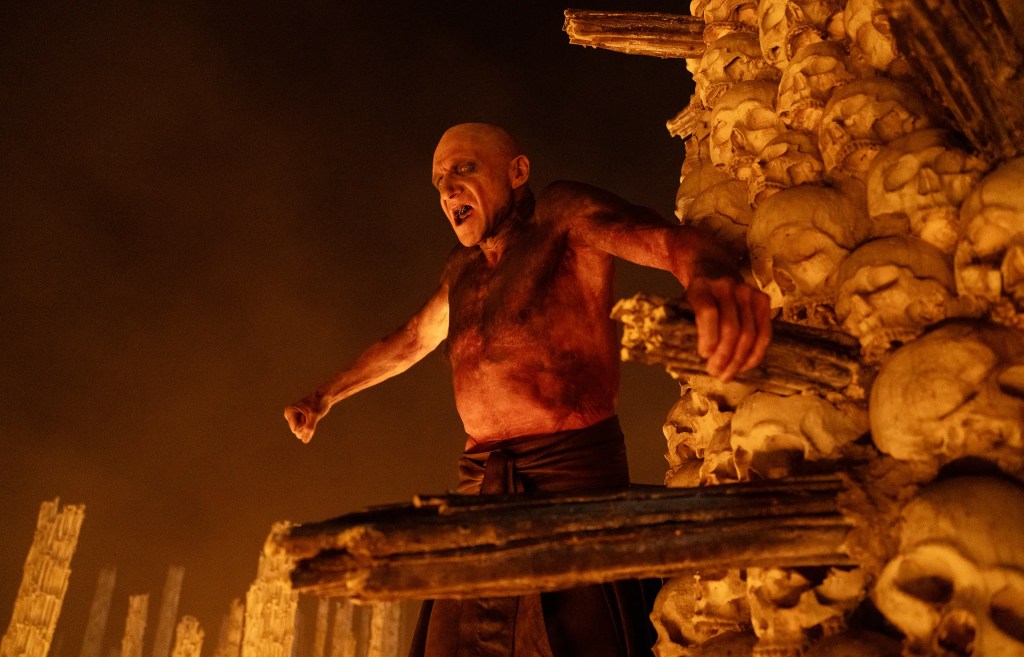
Elsewhere, former GP Dr. Ian Kelson (Ralph Fiennes), last seen crossing paths with Spike during the events of the last film, tends to his ever-growing titular ossuary, a haunting tribute to those lost to the infected. Kelson has also struck up an unexpected relationship with the local Alpha, Samson (Chi Lewis-Parry), having realised the formidable infected has developed a dependency on his tranquilizer. Driven by his medical instincts, Kelson clings to the hope of a cure, forging an unlikely connection with Samson. When these two morally fraught storylines collide, the film lays bare the extremes of human nature in a world undone.
Though shot back-to-back with its predecessor, “The Bone Temple” sees only a handful of top-tier crew members return, with Garland once again steering the script. The brilliant Icelandic composer Hildur Guðnadóttir also returns, weaving a tapestry of dread and suspense that gleefully gets punctured by unforgettable needle drops thanks to the Duran Duran-loving Kelson.
The biggest shake-up comes behind the camera, as franchise veteran Danny Boyle passes the torch to formidable young filmmaker Nia DaCosta. After making her mark in horror with the chilling “Candyman” requel in 2021, DaCosta weathered a brief stumble in the waning Marvel Cinematic Universe, her talents stifled in the underwhelming “The Marvels”. But she has recently returned to form with her acclaimed “Hedda”, which premiered at TIFF in September, and now channels that creative fire into “The Bone Temple”, delivering all the energy and unease fans expect from Garland’s trilogy. Teaming once again with cinematographer Sean Bobbitt, another franchise newcomer, DaCosta infuses the film with her own visual signature while keeping Garland’s existential folk horror at the forefront. Gone are Boyle’s flashy Dutch angles and bullet-time flourishes; DaCosta grounds the story in gritty realism, letting the bizarre narrative breathe.
Most of the previous “28 Years Later” cast members sit this round out, with stars Jodie Comer and Aaron Taylor-Johnson absent, but Alfie Williams returns as Spike, the saga’s resilient heart. Though his role is smaller here, Spike remains the film’s moral compass, untouched by the madness that has consumed others—a fitting trait for someone too young to remember life before the quarantine. His only comfort comes from the hesitant Jimmy Ink (Erin Kellyman), whose journey underscores the theme of lost identity. In a world stripped of order, survivors forget themselves, making them easy prey for cult leaders like Jimmy. Garland, ever the provocateur, continues to skewer political and social issues, dissecting how corrupted beliefs can twist human behavior in the direst circumstances.
Religion takes centre stage in “The Bone Temple”, embodied by the opposing forces of Jimmy, the fervent satanist, and Dr. Kelson, the steadfast atheist. With Fiennes and O’Connell’s powerhouse performances commanding the screen, we get a real sense of their damaged psyches, and though their paths rarely cross, a single electrifying confrontation between them crystallises the film’s exploration of good and evil, and the double-edged sword of faith. The acting duo are magnetic, with Fiennes in particular pouring humour, humanity, and a touch of madness into his role. He anchors one of the film’s most unforgettable moments: a climactic, pyrotechnic spectacle set to Iron Maiden’s “The Number of the Beast”, a scene that could very easily teeter on the edge of absurdity but lands as a showstopper.
O’Connell’s star keeps rising after nearly two decades of steady work. His unhinged turn as Jimmy, paired with his ferocious Irish vampire in Ryan Coogler‘s “Sinners”, all but guarantees his ascent to Hollywood royalty.
After stumbling out of “28 Years Later” last summer, reeling from its mind-bending finale, I am relieved to report that Garland and DaCosta have steered the franchise into thrilling new territory—leaving behind formulaic zombie fare for a wild, thought-provoking folk horror. With Sony now greenlighting a fifth and final chapter, I am hooked, eager to see how this particular trilogy concludes. Here’s hoping the wait is mercifully short.
The Verdict:
As the story veers into uncharted and captivating territory, “The Bone Temple” propels Alex Garland’s zombie saga into daring new realms. While some may miss the familiar pulse of classic zombie action, the film’s transformation into modern existential folklore is far more compelling and promises to deepen its legacy in the upcoming finale.
28 Years Later: The Bone Temple is now showing in UK Cinemas
 Dan Loves Film
I’m curious, when you think about how the film blends survival against the infected with the twisted choices of the living, which moment or character decision stood out to you as showing the deepest cost of trying to rebuild humanity in a broken world?
LikeLiked by 2 people
I think the conflicting decisions between both Jimmy and Kelson show how wide humanities actions could be. With snippets of more mentally stable survivors sprinkled in to further highlight these extremes
LikeLiked by 1 person
Excellent reviews as always. 28 Years Later: The Bone Temple is a movie that I am definitely looking forward to seeing soon. I have been a big fan of this zombie franchise ever since I first saw 28 Days Later years ago. What I love most about these movies is their depiction of zombies with humanity. Ralph Fiennes is one of my favourite actors working today and has yet to disappoint me in his films. So, for these reasons, I will definitely check this out in theatres. It sounds like the kind of movie that I will love.
Here’s my thoughts on 28 Years Later:
LikeLiked by 1 person
You are in for a treat with Fiennes here.
LikeLiked by 1 person