
Dir: Bi Gan
Cast: Jackson Yee, Shu Qi, Mark Chao, Li Gengxi, Huang Jue, Chen Yongzhong
Though its intentionally elusive story may test your patience, Bi Gan’s meditative and masterfully crafted sci-fi epic dazzles the senses and stands as a breath-taking tribute to the art of cinema
Each year, the Cannes Film Festival unleashes a wave of cinematic wonders, crafted by both legendary directors and rising stars from every corner of the globe. While much of the 2025 line-up has already reached and dazzled audiences worldwide, with films like Joachim Trier‘s “Sentimental Value” and Kleber Mendonca Filho‘s “The Secret Agent” now vying for glory at the 98th Academy Awards, there is one film whose release I have awaited with more anticipation than any other.
“Resurrection” marks the latest creation from 36-year-old Chinese auteur Bi Gan, whose previous films, “Kaili Blues” in 2015 and “Long Day’s Journey into Night” in 2018, managed to cast hypnotic, almost Lynchian spells on audiences. My anticipation for his work springs from Bi Gan’s fearless artistry, with his films often drifting through non-linear, dream-soaked narratives, often building to breath-taking, hour-long unbroken shots that have become his signature.
Following its UK premiere at the BFI London Film Festival back in October, Trinity Cine Asia acquired distribution rights, and I finally seized the chance to experience it myself this week, after its limited theatrical release. Though I am still wrestling with my feelings about Bi Gan’s most ambitious project yet, the sprawling 160-minute film radiates the hallmarks of a visionary at the peak of his powers. Like his earlier works, this is pure dream cinema—a swirling kaleidoscope of colours, sets, visual styles, and cinematic eras, all woven together as a tribute to the art form’s rich history.
The film spins a labyrinthine tale, eschewing conventional narrative. Set in a dystopian world where humanity has traded dreams for longer lives, a mysterious woman known as “The Big Other” (Shu Qi) tracks down a monstrous “Deliriant” (Jackson Yee), who hides within the flickering shadows of a German expressionist film, consuming poppies out of desperation to keep his dreams alive. Unable to grasp his obsession, she lets him relive a century of memories through various dreams before his final breath.
From the roaring 1920s to the dawn of the new millennium, the film unfolds as a series of anthological tales. Each segment follows the deliriant in different guises, journeying through his past lives and exploring the six senses of Buddhism: sight, hearing, taste, smell, touch, and mind.
Though the film may intentionally forgo structure and clarity, it is compensated for by Bi Gan’s singular vision. The director masterfully borrows from a vast arsenal of cinematic techniques, each a nod to the art form’s storied past. Having been familiar with his earlier works going in, I was prepared for his elusive storytelling, which will surely test viewers seeking a more fulfilling and straightforward narrative. Instead, Bi Gan invites us to reflect, to lose ourselves in the questions his work of art poses.
Bi Gan’s meditative style invites viewers not just to witness his visual poetry but also challenges them to assemble meaning from its fragments themselves. Some segments, unsurprisingly, succeed better than others at conveying the film’s meaningful but opaque messaging, yet the film’s enigmatic spell continues to resonate with me as I muse over it. This is cinema as pure art, a feat that only the boldest and most gifted filmmakers dare to attempt, let alone achieve.
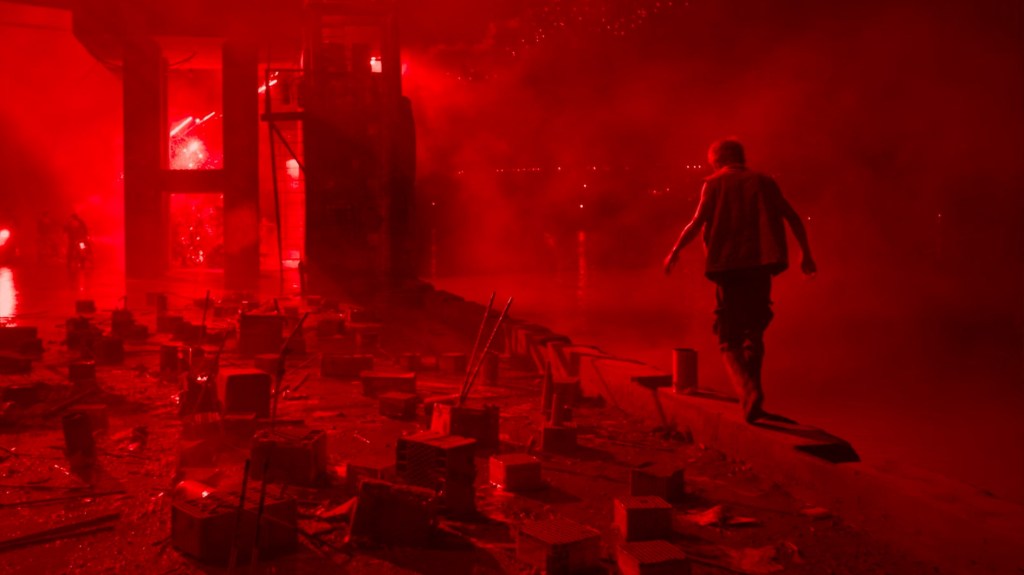
Bi Gan’s reputation as a visual storyteller is elevated by extraordinary period production design that not only resurrects four distinct eras of the twentieth century but also echoes the filmmaking techniques of those eras. Yet, it is the film’s breath-taking visuals—brought to life by Dong Jingsong’s remarkable cinematography—that linger most. While the six sequences see Bi Gan experimenting beyond his usual languid pace, Jingsong still manages to deliver a signature one-shot take from his past collaborations with Bi Gan. While it runs slightly shorter than the final act of the filmmaker’s previous outing, the fourth and final dream unfolds in a mesmerizing “oner”, trailing a more youthful deliriant through neon-lit backstreets, smoky karaoke bars, and moonlit harbours, as he becomes entranced by a mysterious young vampire. The segment’s vivid blood-red palette conjures the spirit of 90s Hong Kong new wave cinema, especially the films of Wong Kar-wai, one of several historic filmmakers whose influence pulses through “Resurrection”.
Through these homages, Bi Gan channels the spirits of cinema’s past, weaving together styles from silent film, stop-motion animation, and caption cards into the shadowy moods and rain-drenched atmosphere of neo-noir. Each segment stands alone, tied to its specific Buddhist sense, and together they question the value of creativity in a world increasingly obsessed with safety and longevity. This hesitance to champion bold filmmakers has drawn criticism toward Hollywood, where safe, profitable franchises like the Marvel Cinematic Universe overshadow original voices. While “Resurrection” prompts reflection on broader social themes, its true heartbeat is the celebration of cinema itself.
The Verdict:
While its unconventional and demanding narrative might turn away some viewers, “Resurrection” lets Chinese auteur, Bi Gan, elevate his surrealist vision to dazzling new heights. The film’s quite astonishing visuals and reflective tone alone are reason enough to experience it on the big screen.
Resurrection is now showing in select UK Cinemas
 Dan Loves Film
Interesting read.
LikeLiked by 1 person