Dir: Christopher Nolan
Cast: Matt Damon, Tom Holland, Anne Hathaway, Robert Pattinson, Lupita Nyong’o, Zendaya, Samantha Morton, Benny Safdie, Charlize Theron, Elliot Page, John Leguizamo, Jon Bernthal, Himesh Patel, Corey Hawkins
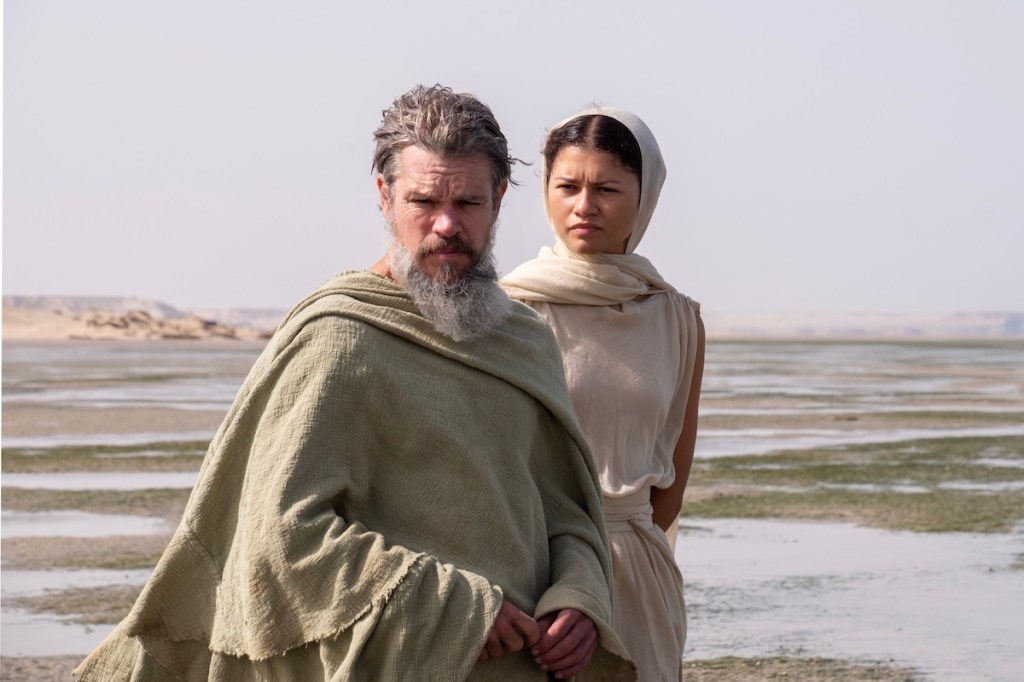
Though weighed down by a clunky structure and missing an emotional anchor, Christopher Nolan’s thunderous retelling of the epic Greek poem largely triumphs with unforgettable set-pieces and a rewarding finale
Is Christopher Nolan the greatest filmmaker of the 21st Century? That question still sparks debate, but one thing is certain: the Oscar-winner has carved out a place as one of modern cinema’s most influential and beloved directors. For nearly three decades, Nolan has dazzled audiences with his visceral, immersive filmmaking, delivering true spectacle to the big screen. Whether crafting intimate psychological thrillers like Memento (2000) and Insomnia (2002), reinventing the superhero genre with his gritty “Dark Knight” trilogy, or bending minds with high-concept sci-fi, Nolan’s work is always an event. While he has revitalized many genres, it’s his original, mind-bending projects such as Inception (2010) and Interstellar (2014) that have cemented his reputation, each a testament to his signature non-linear storytelling and ability to leave audiences spellbound.
Nolan has all but inherited Steven Spielberg’s crown as the master of blockbuster cinema, championing practical effects that stand the test of time. Among cinephiles like myself, the mere announcement of a new Nolan film sparks a wave of anticipation and excitement, so it was no surprise that tickets for his latest project—a bold adaptation of the ancient Greek epic, The Odyssey—began to sell out in record time. Teaser trailers began appearing in cinemas over a year ago, at first simply counting down the days to the July 17th release. As the date approached, we were treated to glimpses of the fantastical yet grounded world Nolan had meticulously crafted. The tantalizing marketing campaign wasn’t without controversy, as some self-proclaimed fans criticized his casting and production choices. The ethnically diverse ensemble drew complaints from more conservative viewers, who bizarrely called it “inaccurate”—a puzzling stance, given that Homer’s tale is pure fiction, filled with magic, monsters, and gods. Questioning the casting of talents like Lupita Nyong’o and Elliot Page seems not only misguided but also inexcusable.
I was instantly intrigued by the first full trailer released a few months ago. As a long-time admirer of Nolan’s work and his dedication to in-camera effects, I was eager to see how he would bring the epic’s most fantastical moments to life without leaning on CGI, a tool he rarely uses. Tackling fantasy adventure is a bold and unexpected move for Nolan, especially with a story as ancient and well-trodden as The Odyssey—a fable that has been retold, reimagined, and reinvented across countless art forms since it was first recited around 750 BCE. Over the centuries, the poem has evolved, passed down through generations before finally being written down. It is the original epic, adapted for the screen many times, from faithful renditions to inventive takes like the Coen Brothers’ crime caper “O Brother Where Art Thou?” (2000).
Nolan’s take on Homer’s epic stays rooted in tradition, yet, true to his signature style, the story leaps through time, weaving between Odysseus (Matt Damon) and his longing wife, Penelope (Anne Hathaway), who waits in Ithaca. For those new to the tale, or whose only brush with it was that memorable episode of “The Simpsons”— which was admittedly my own first encounter—the plot centres on Odysseus, the legendary Greek king. After sailing off to help reclaim Helen (Lupita Nyong’o) from Troy two decades ago, he still has not returned home, leaving his kingdom vulnerable to a swarm of suitors. Led by the scheming Antinous (Robert Pattinson), these men vie for Penelope’s hand, eager to seize the absent king’s throne.
In the present, Odysseus’ son Telemachus (Tom Holland) searches for answers, convinced that his father will one day return to banish the opportunistic suitors who are exploiting Zeus’ law of hospitality. Through vivid flashbacks, we witness Odysseus’ gruelling odyssey: facing a Cyclops, enduring Poseidon’s fury, and confronting a sorceress. Stranded on an island with Calypso (Charlize Theron), slowly recalling his memories and alone without his men, Odysseus’ journey unfolds in fragments of longing and peril.
Despite being a devoted fan of Nolan’s work and firmly believing he has yet to make a bad film, I approached my first screening of “The Odyssey” with a hint of scepticism I couldn’t quite explain. Maybe it was the uncertainty of seeing him step away from high-concept originals to adapt a well-known, seemingly straightforward story. Or perhaps I wondered how he would bring creatures like the cyclops or the six-headed Scylla to life using practical effects, without sacrificing the grandeur or grounded tone he’s known for. Thankfully, Nolan’s modern take on Homer’s epic delivers, thanks to his unmatched sense of scale, spectacle, and his knack for crafting unforgettable set-pieces. Visually and technically, the film cements Nolan’s status as a master of the modern blockbuster. His thunderous use of sound—including a cyclops’ shriek that nearly left me deaf—paired with Hoyte van Hoytema’s breath-taking visuals, fully immerses you in this ancient world of gods and monsters.
“The Odyssey” marks the fifth time Nolan has teamed up with Dutch cinematographer van Hoytema, a creative partnership that first took flight with 2014’s “Interstellar”. Their last venture, “Oppenheimer”, saw both artists take home their first Academy Awards in 2024. With this new film, Nolan and van Hoytema have set a new standard by capturing every frame in 70mm IMAX, amplifying the story’s grandeur and visual impact. The lush cinematography, paired with Nolan’s signature hands-on style, draws viewers deep into worlds that feel both vast and intimate. Vivid costume and production design transform the Mediterranean settings into living, breathing landscapes. For me, this stands as the most captivating portrayal of Greek myth on screen, though I am sure if you asked him, Nolan might tip his hat to Ray Harryhausen for inspiration.
While Nolan’s strengths as a filmmaker remain undeniable, his screenwriting has faced criticism, especially regarding his portrayal of women. Thirteen films in, and we still await a true female lead from Nolan. Although there has been some progress—Emily Blunt’s powerful turn as Kitty Oppenheimer comes to mind—his scripts often feel like stories of men serving men, and “The Odyssey” is no exception. Aside from Anne Hathaway’s standout performance as Penelope, most female characters are side-lined or omitted altogether. Zendaya, Mia Goth, and Lupita Nyong’o, despite playing some iconic Greek figures such as Athena and Helen of Troy, are given little to work with, while the bulk of the character development is reserved for Damon’s Odysseus and Tom Holland’s Telemachus.
Despite the film’s progressive casting, I found issues with some of the big-name actors. Because the supporting characters lack nuance, whenever the likes of Zendaya, Theron, or Pattinson appeared, I struggled to see their characters rather than the celebrities themselves. With so little character work to draw from, it was hard for them to truly inhabit their roles. The real standouts are the veteran actors: John Leguizamo brings warmth, humour and loyalty to Eumaeus, Odysseus’ blind servant, while Samantha Morton’s brief turn as Circe is both haunting and unforgettable. Her scenes are among the film’s most chilling, and despite her character’s actions, Morton imbues Circe with a depth and unspoken history that makes her surprisingly sympathetic. It’s a shame we don’t get to explore more of her past. I guess this is part and parcel with the story’s episodic structure; while epic in scale, it can become repetitive as Odysseus and his men face one mythological challenge after another. Each set-piece is bombastic, but the constant time jumps and shifts in location made it difficult for me to stay emotionally invested in Odysseus’ journey home and his longing to reunite with his family.
This leads me to another recurring issue in Nolan’s work: the absence of a true emotional anchor. Aside from the genuinely heart-wrenching “Interstellar”, his films rarely invite deep emotional investment. While this might be expected in superhero flicks or thrillers, a story like this—centred on a romance separated by twenty years—should have more emotional weight. As “The Odyssey” reached its thunderous finale, I couldn’t shake the feeling that something was missing. Instead of rooting for Odysseus and Penelope’s reunion, I found myself more invested in the fate of Argos, Odysseus’ loyal old dog, who clings to life in the hope of seeing his master again.
These may sound like major criticisms, but only because Nolan has set the bar so high over the past twenty-eight years that I expect nothing less than brilliance. There’s no denying he has translated the ancient poem for a modern audience with his trademark bravado. By shifting the focus from the agony of the journey to the inner turmoil and aftermath of war—specifically the siege of Troy—he introduces contemporary themes that will spark discussion for years. With his expert craftsmanship and a cast led by Damon’s battle-hardened yet flawed Odysseus, Nolan’s reputation remains untarnished. As his latest film breaks box-office records, I have no doubt the British director will continue to captivate and astonish audiences for years to come.
The Odyssey is now showing in UK Cinemas
 Dan Loves Film