Dir: David Robert Mitchell
Cast: Anne Hathaway, Ewan McGregor, Maisy Stella, Christian Convery
David Robert Mitchell’s wild Amblin-inspired fever dream is a tonal rollercoaster, with an unnecessarily great Anne Hathaway battling to rescue her chaotic suburban family from a prehistoric nightmare
Modern indie auteur David Robert Mitchell burst into the spotlight in 2014 with his haunting allegorical horror “It Follows”. Although it was only his second feature, following the little-seen coming-of-age comedy drama “The Myth of the American Sleepover” four years prior, “It Follows” truly marked his arrival, with its AIDS-inspired supernatural chills earning it a place among the decade’s most celebrated genre films. The film showcased Mitchell’s remarkable range, leaping from gentle comedy-drama to nerve-jangling horror in a single bound. He would later stretch his creative muscles even further with the polarizing neo-noir comedy thriller “Under the Silver Lake” (2018), proving his willingness to defy genre expectations.
Though Mitchell has dabbled in a wide array of genres, one unmistakable thread runs through his films: a deep reverence for cinema’s past. His anachronistic work often feels out of time, as in “It Follows”, where he channels the moody atmosphere of John Carpenter’s 1970s and 80s classics, the relentless entity echoing the unstoppable menace of Michael Myers or The Thing. In “Under the Silver Lake”, he tips his hat to the golden age of Hollywood neo-noir, but with a modern twist. Even if his bold, tonally wild third film divided critics, I can’t help but admire his ambition to resurrect the spirit of bygone eras for today’s audiences, even when the pieces don’t quite fit.
After the critical and commercial misfire of his last film, which left audiences scratching their heads and landed him in Hollywood purgatory, it seemed a waste of Mitchell’s talent and vision. But now, eight years after that ill-fated third outing, Mitchell returns with his boldest and most ambitious project yet—and by far his biggest, with a rumored budget north of $100 million. “The End of Oak Street”, an original story penned and co-produced by Mitchell, finds backing from J. J. Abrams and his Bad Robot label, a fitting match for its wild, genre-blurring premise. Once again, Mitchell crafts a cinematic time capsule, this time channelling the early days of Amblin Entertainment and the genre-bending magic of Steven Spielberg, from the late 1970s through the era-defining “Jurassic Park” in 1993.
With such a clear nod to Spielberg, it’s no wonder Abrams is front and centre in the marketing for this dinosaur adventure, often hailed as a modern Spielberg himself for his knack for mystery, nostalgic sci-fi, and family-friendly spectacle. The film’s 80s setting even echoes Abrams’ own “Super 8” (2011). Yet, Mitchell takes a refreshing detour from the usual neon-soaked, glossy 80s nostalgia that has flooded pop culture since “Stranger Things”. Instead, he opts for a muted colour palette that feels more 1970s than 80s, reflecting the central family’s financial struggles and grounding the story in a more authentic, lived-in world. Mitchell’s signature anachronism is alive and well.
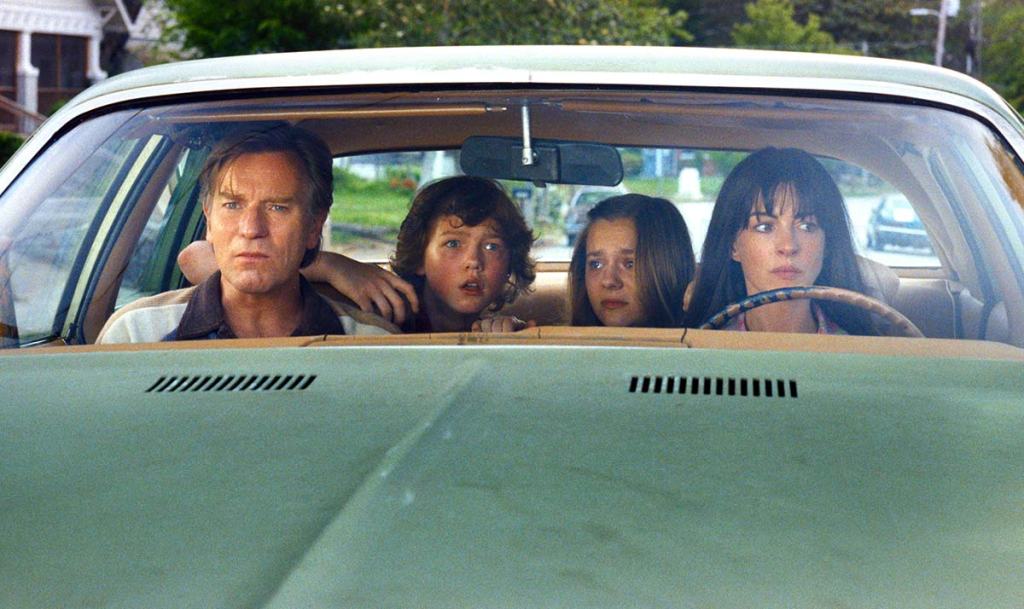
The film introduces the Platt family, who appear to be the picture of happiness: Denise (Anne Hathaway), Greg (Ewan McGregor), their teenage children Audrey (Maisy Stella) and Brian (Christian Convery), and their loyal dog Starbuck. Beneath this cheerful façade, cracks are beginning to show. Denise quietly dreams of escaping her family, pouring her secret desires into the pages of a novel, while Greg hides the truth about losing his job and pretends his pizza delivery gig is just a side hustle. The neighbours remain blissfully unaware of the storm brewing behind the Platts’ closed doors.
After a series of strange events on Oak Street, including mysterious white lights flashing during a storm, the Platt family wakes to a world turned upside down: no power, no water, and an eerie silence. Denise and Greg leave their children safely at home, step outside to investigate, and are stunned to find their street encircled by a wild prehistoric jungle. Dinosaurs soon emerge from the shadows, turning their quiet suburb into a deadly hunting ground. Barricaded inside, Audrey, inspired by her fascination with Carl Sagan, pieces together the impossible: a wormhole has hurled their neighbourhood millions of years into the past. Now, the family must race to find another wormhole before they become extinct.
If viewers thought Mitchell’s last film was tonally odd, they’re in for an even wilder ride with his latest. “The End of Oak Street” was one of my most anticipated films of the summer—I’ve long admired Mitchell’s work and was eager to see how he’d handle such a massive canvas. After watching it, I’m left torn, having witnessed 100 minutes of creative choices that swing wildly in tone. It feels like two movies wrestling for control: on one side, a family-friendly dinosaur romp brimming with nostalgia and popcorn fun; on the other, a grim creature feature where anyone can meet a sudden, brutal end and the real drama comes from the characters’ personal struggles, not the prehistoric threats. The result is a film packed with standout moments and expertly staged set-pieces, but emotionally, it’s a rollercoaster with no clear direction.
Moments of genuine tension are quickly undercut by misplaced silliness, while scenes that start out light-hearted can suddenly veer into darkness. I found myself laughing when I was supposed to be tense, and caught off guard by drama where I expected levity. Nowhere is this tonal whiplash more apparent than in the performances: the four leads seem to be acting in entirely different movies. McGregor brings a breezy, Amblin-style charm, while Hathaway delivers raw, almost unsettling realism, her monologues about domestic strife among the most gripping I’ve seen. The result is a chaotic blend, as if the film itself can’t decide what it wants to be—much like the strange discovery in their neighbour’s backyard, it’s a fascinating mess.
Visually, though, the film is a feast. The deliberately muted early-80s look feels fresh, and the dinosaurs—often rampaging in broad daylight—are both impressive and more scientifically accurate than most cinematic counterparts. Michael Giacchino’s John Williams-inspired score adds a sweeping, nostalgic touch. Yet, despite its entertainment value and moments of brilliance, the film feels like a missed opportunity. The wild premise could have fuelled a truly unforgettable summer blockbuster, but the muddled tone and Mitchell’s refusal to settle on a genre leave it brimming with untapped potential.
There are certainly bright spots, and it’s a relief to see Mitchell back behind the camera. I wouldn’t be surprised if this film finds a cult audience in the years to come. As for what’s next, I’m crossing my fingers that he finally delivers the long-awaited sequel to “It Follows”, since nothing has yet matched the brilliance of his sensational sophomore effort.
The End of Oak Street is now showing in UK Cinemas
 Dan Loves Film
Leave a comment