Dir: Guillermo del Toro
Cast: Oscar Isaac, Jacob Elordi, Mia Goth, Felix Kammerer, Lars Mikkelsen, Christoph Waltz, Charles Dance, David Bradley, Ralph Ineson, Burn Gorman
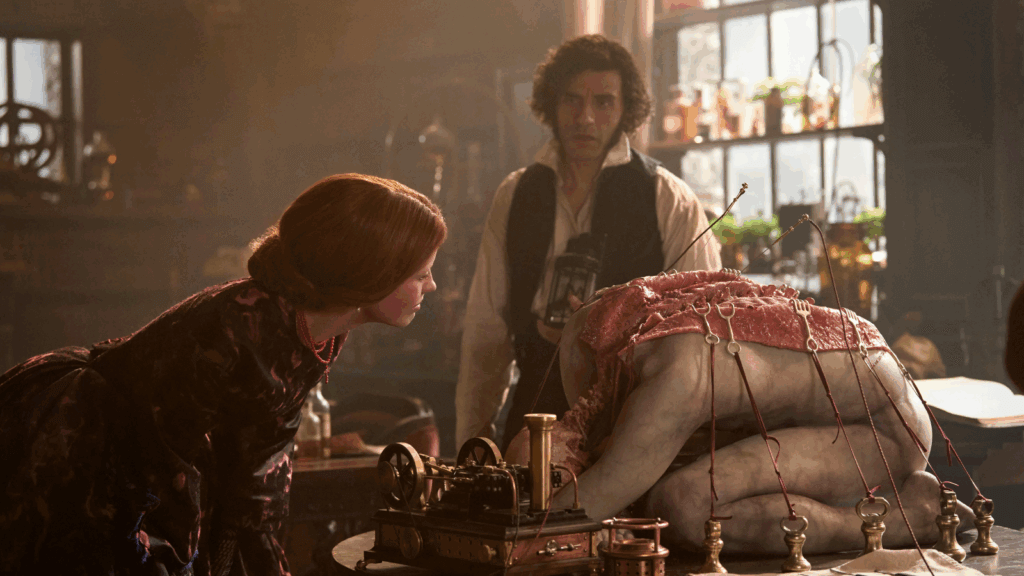
Every frame glows with del Toro’s reverence for the source material, but this unwavering faithfulness leaves little room for unexpected delights. Coupled with sluggish pacing, the result sometimes feels like a beautiful but tiresome journey
No contemporary filmmaker conjures the haunting allure of gothic fantasy on screen quite like Guillermo del Toro. While Tim Burton’s devotees may argue otherwise, del Toro’s artistry eclipses that of his American peer, with his mesmerizing creatures and immersive worlds, weaving fairy tales that shimmer with both dread and hope. Ever since I was spellbound by his gothic vision in 2006’s “Pan’s Labyrinth”-which is subsequently one of my favourite films of all time- I have found myself eagerly awaiting each new magical realm he unveils.
Del Toro’s lifelong fascination with classic movie monsters pulses through his filmography, where terrifying yet strangely beautiful creatures prowl and enchant. From the fantastical fairytale creations of his Spanish Civil War-era masterpiece to the enigmatic Amphibian Man in the Oscar-winning “The Shape of Water”, his creations linger in the imagination. Even when monsters take a back seat, del Toro’s gothic vision crafts uncanny worlds that transport us into eerily familiar yet deliciously macabre landscapes.
After breathing new life -pun intended- into Carlo Collodi’s fantasy tale “The Adventures of Pinocchio” for Netflix in 2022, it felt almost inevitable that del Toro would next tackle arguably the most famous monster novels of all time, Mary Shelley’s legendary “Frankenstein; or, the Modern Prometheus”. This 1818 classic is not only a highly regarded piece of literature in its own right, but it also set the foundations for science fiction across all media, and continues to echo through literature and cinema with its probing of scientific ambition and morality. Its legacy has inspired countless adaptations, from Boris Karloff’s iconic turn as the creature in James Whale’s 1931 horror classic, to Kenneth Branagh’s bold 1994 interpretation, and quirky modern spins like “Lisa Frankenstein” (2024) and “Frankenweenie” (2012), to name a few. Yet del Toro’s devotion to Shelley’s original shines through, as he crafts what may be the most faithful and epic adaptation yet.
Set to debut on Netflix next month, “Frankenstein” first dazzled audiences at the Venice Film Festival before placing as first runner-up at TIFF shortly after. I was lucky enough to experience an early screening of del Toro’s labour of love, just ahead of its brief theatrical run and highly anticipated streaming release on November 7th.
The film begins with a chilling cold open, plunging us into a desolate, icy wasteland where the wounded and egotistical mad-scientist, Victor Frankenstein (Oscar Isaac), is rescued by the crew of a beleaguered ship bound for the North Pole. After a monstrous, unstoppable figure claims the lives of several sailors, the ship’s captain (Lars Mikkelsen) demands answers. Victor, shrouded in mystery and regret, begins to unravel the tale of how he brought “The Creature” (Jacob Elordi) to life.
Victor and his younger brother William grew up under the stern gaze of their father, the famed Dr. Leopold Frankenstein (Charles Dance), whose rigid teachings forged Victor’s anatomical brilliance. Eager to push the boundaries of science, Victor is exiled from the scientific community after a shocking courtroom demonstration of partial reanimation. His audacity catches the eye of wealthy arms magnate and benefactor Henrich Harlander (Christoph Waltz), who offers to bankroll Victor’s quest to create life, completely enamoured by it. Amidst this, Victor finds himself drawn to Henrich’s mistifying niece Elizabeth (Mia Goth), engaged to the now-grown William (Felix Kammerer), who is equally eager to assist in his brother’s bold, forbidden experiment.
From the opening moments, del Toro’s vision sweeps you into a gorgeously macabre world, brimming with spectacle, awe, and dread. His signature style breathes new life into Mary Shelley’s classic, capturing its haunting atmosphere, and dreary period setting more faithfully than any previous adaptation. Unlike James Whale’s legendary 1931 film, which strayed far from the novel’s narrative, del Toro remains true to the source, weaving a tapestry of stark, otherworldly sets and vibrant, flowing costumes—especially those worn by Mia Goth’s Elizabeth. This contrast mirrors the duality of Frankenstein’s creation: the terror and despair he inspires, reflected in the towering, forbidding laboratory, and the compassion and innocence embodied by Elizabeth, who scolds Victor for his hubris. The film masterfully underscores the novel’s idea that Victor, not his creation, is the true monster.
Though del Toro tweaks the story, his script remains so loyal to Shelley’s novel that it rarely surprises. The film dazzles with its visuals and practical effects, hammering home themes of reckless ambition and the heavy cost of playing god. Yet, this devotion to the source leaves little room for fresh insight. Even without having read the original, I found the film’s predictability underwhelming. Del Toro’s passion leads him to pack in nearly every detail from Shelley, stretching the runtime to a bloated 150 minutes. Split into two parts—one from Victor’s view, the other from the Creature’s—the film’s second act arrives so late that the audience in my gala screening audibly groaned when a title card for chapter 2 lit up the screen, having thought the story was reaching its finale. By the time the Creature’s more sympathetic tale unfolds in this second chapter, I had already become emotionally detached, the film’s conclusion drained of its intended weight.
While style may sometimes overshadow substance, del Toro’s artistry is so commanding that his visual flair compensates for many of the film’s flaws. The cast delivers strong performances, with Jacob Elordi in particular shining as the tragic Creature. Towering above his co-stars, Elordi brings both imposing presence and raw vulnerability to the role, redefining the iconic monster. Once dismissed for his early work in schlocky, streaming fare like “The Kissing Booth” and its sequels, Elordi has silenced critics by embracing bold, challenging roles with acclaimed directors such as del Toro and Sofia Coppola. Soon, he will share the screen with Margot Robbie in Emerald Fennell’s provocative take on Emily Brontë’s “Wuthering Heights”, marking his second collaboration with the director after his memorable turn as the entitled Oxford alumni, Felix, in “Saltburn” back in 2023.
The Verdict:
Guillermo pours his passion for the legendary gothic tale into breath-taking visuals and eerily gorgeous production design, yet his devotion to Mary Shelley’s original keeps this modern retelling from breathing new life into a story we already know so well.
Frankenstein is showing in select cinemas from 17th October before streaming on Netflix from 7th November
 Dan Loves Film
Great review as always: sadly, it also reminds me of “Killers Of The Flower Moon”, where the reverence for the subject matter makes the cinematic journey far too solemn and ponderous.
LikeLiked by 1 person
Definitely similarities in that aspect, both were slogs to get through
LikeLike
I’m now looking forward to seeing it.
Great post! Thanks!!! 👍
LikeLiked by 1 person
I Think Mia Goth would be good choice as Harley Quinn In James Gunn Reboot DCEU
LikeLike
I Think Jacob Elordi would be great choice as Cyclops/Scott Summers In MCU
LikeLike