Dir: Lee Cronin
Cast: Jack Reynor, Laia Costa, May Calamawy, Natalie Grace, Veronica Falcon, Shylo Molina, Billie Roy, Hayat Kamille
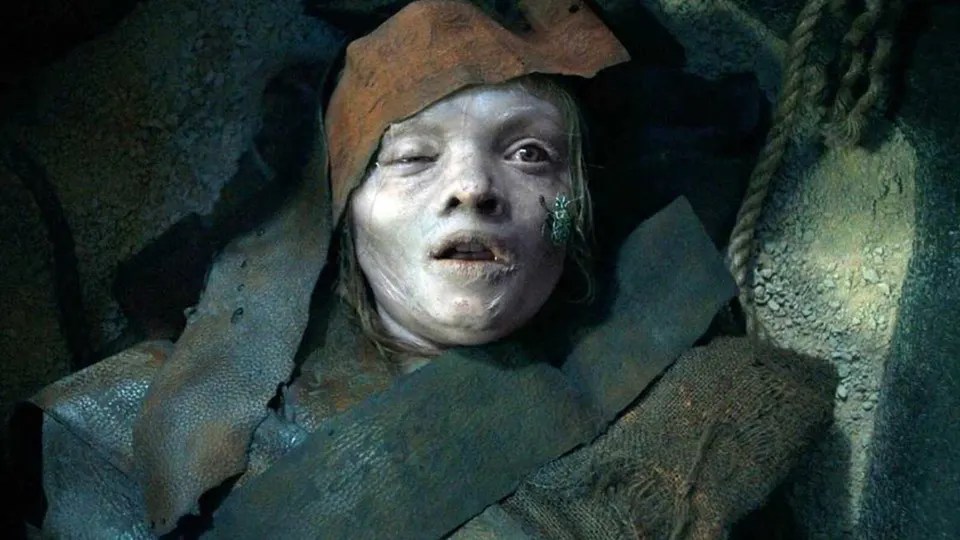
Horror auteur Lee Cronin breathes fresh life into the classic movie monster, but despite an abundance of gross-out gore and high domestic stakes, the story drags and unravels into a gruesome, bloody mess
As I scanned the 2026 film line-up to kick off the new year, one title instantly grabbed me: “Lee Cronin’s The Mummy”. Having grown up on the popular, swashbuckling adventure from 1999, I was hooked by the prospect of Cronin—the director who made a cheese grater unforgettable in “Evil Dead Rise” (2023)—taking the reins. His flair for nihilism and suffocating tension promises a bold new spin on a monster that has long since lost its bite after the Dark Universe fizzled out prematurely.
For those, like me, who felt the franchise had lost its way amidst the sterile action-spectacle of the 2017 attempt, that not even the great Tom Cruise could save, the premise here is thankfully more focused and gloriously grim. Eschewing the global stakes of Universal’s failed Dark Universe, Cronin brings the terror home—literally. We follow Charlie (Jack Reynor) and Larissa (Laia Costa), a young couple whose lives are shattered when their young daughter, Katie, is abducted from their Cairo home by a mysterious local woman. The narrative skips forward eight years to find the couple living in the wreckage of their grief in a secluded, shadow-drenched Albuquerque estate, until they are unexpectedly informed by Egyptian authorities that their daughter has been found.
But the sixteen-year-old Katie (Natalie Grace) who returns is a stranger. Found by archaeologists sealed inside an ancient sarcophagus, she is mute, wrapped in parchment scrawled with forgotten symbols. Ignoring the warning signs—her wild, self-destructive outbursts—Charlie and Larissa bring her home, hoping to rebuild their family with younger siblings Sebastian (Shylo Molina) and Maud (Billie Roy). Yet as the bandages unravel from Katie’s skin, something monstrous begins to seep into their lives, preying on her and everyone she loves.
Cronin plunges headfirst into the possession subgenre, wielding suffocating soundscapes and jolting practical effects to conjure a fresh nightmare. Instead of recycling the tired tropes of bandaged ghouls from the Boris Karloff era, he crafts a vision all his own. His technical prowess as a modern horror auteur shines, raising the stakes within the claustrophobic confines of the family home and unleashing a torrent of stomach-churning body horror. Fans of his “Evil Dead” instalment will recognize his flair for grotesque practical effects—equal parts revolting and darkly funny.
By weaving body horror into the mummy legend, Cronin stamps his mark on this mainstream reboot. It may never inspire the same nostalgia as Brendan Fraser’s dashing adventures in his own “The Mummy” trilogy, but it is poised to earn cult status among horror devotees. Cronin’s signature visual flair—especially his split-diopter shots—keeps the film immersive, even as the supernatural chaos erupts in the final act. Some viewers and critics may be put off, but I admire the raw authenticity Cronin brings despite this being his most ambitious project yet.
Cronin knows how to draw out the best in his cast, and Reynor and Costa shine as the desperate parents. Their dogged pursuit of hope feels painfully real, thanks to their crackling chemistry. Reynor’s grounded pragmatism and dawning despair ratchet up the tension, while Costa’s exhausted, grief-soaked resolve makes her both the heart and the catalyst for chaos. Her refusal to commit Katie, despite the danger, pushes Charlie to seek help alone, his journalist instincts kicking in until he nearly forgets the subject is his own daughter—deepening the rift between husband and wife.
Where Cronin stumbles is in the film’s bloated runtime. I love a sprawling epic when it earns its length, but at just over two hours, this intimate horror outstays its welcome. The opening act brims with promise—tight pacing, intrigue, and atmospheric Egyptian backdrops. But once Katie returns, the scares grow repetitive, and Larissa’s stubbornness starts to strain belief. The story unravels like Katie’s bandages: the more that’s revealed, the less focused it becomes. The investigative sub-ploy and long stretches between scares sap the tension, and the practical effects are abandoned for a CGI-heavy finale that feels more Dark Universe than gritty, 18-certificated body horror.
Fans of Cronin’s work will find plenty to enjoy, but as the story crumbles like the desiccated flesh of its titular monster, the flaws become impossible to ignore. The gleeful gore is a treat, yet it feels like a familiar encore after the sharper, more wickedly funny “Evil Dead Rise”.
The Verdict:
“Lee Cronin’s The Mummy” breathes new life and a welcome splash of gore into the legendary monster. Even as the story unravels and loses its way in the final act, there is still plenty here to keep me hooked on Cronin’s vision and eager for whatever chilling surprises he has in store for horror fans next.
Lee Cronin’s The Mummy is now showing in UK Cinemas
 Dan Loves Film
This is a sharp and engaging piece of film criticism that immediately shows a strong command of tone and audience awareness.
What stands out most is the confident framing in the opening paragraph—you don’t just introduce the film, you situate it within personal nostalgia, franchise history, and the director’s established style. That gives the review both context and personality, which is exactly what makes criticism feel alive rather than mechanical.
LikeLiked by 1 person
Always great reviews…
LikeLiked by 2 people
My wife said too much cg but story was good, I was in. A headspace where it was so gross at times I had to not watch, I had taken a gummy so I think that had a bit to do with it.
LikeLiked by 2 people
Haha yeah that may have made an impact
LikeLike